Over 20 Years Experience in the Forensic Examination of Computers & Mobile Phones.
Digital Forensic Expert Investigations within Criminal, Family and Commercial Across the UK.
Digital Forensic Expert Witnesses with over 25 Years Experience.
Legal Aid Accepted and ISO 9001 Accredited for 14 years.
Independent Computer Forensics Experts Delivering Reliable Digital Evidence Throughout the United Kingdom
When digital evidence becomes central to a legal dispute, criminal investigation, family court proceeding or corporate enquiry, you need more than an IT professional—you need an experienced computer forensics expert who understands both the technical and legal aspects of digital evidence.
Athena Forensics provides independent computer forensic investigations, expert witness services and digital evidence analysis for solicitors, barristers, businesses, insurers, government organisations and private clients throughout the United Kingdom. We recover, preserve and interpret digital evidence using recognised forensic methodologies, ensuring that every examination is conducted objectively and to the highest professional standards.
Our role is to establish the facts. Whether investigating allegations of fraud, recovering deleted files, examining internet activity or preparing an expert witness report for court, we provide technically accurate, impartial and clearly explained findings that can withstand detailed legal scrutiny.
What Does a Computer Forensics Expert Do?
A computer forensics expert examines digital devices using specialist forensic techniques to recover, preserve, analyse and interpret electronic evidence.
Unlike conventional IT support, computer forensics focuses upon identifying evidence that may later be relied upon within legal proceedings.
Every action undertaken during an examination must therefore preserve evidential integrity and allow findings to be independently verified.
A professional computer forensics expert may determine:
- who used a computer;
- when particular activity occurred;
- whether files were deleted;
- whether data was copied to USB devices;
- what websites were visited;
- whether documents were created or modified;
- whether cloud storage was used;
- whether attempts were made to conceal evidence;
- whether malware was present; and
- whether digital evidence supports or contradicts witness accounts.
These findings frequently become significant pieces of evidence within criminal investigations, civil litigation and corporate enquiries.
How Can Our Digital Experts Assist?

Our computer forensic expert team are able to review and examine the data present on computers, phones and memory cards for any data present, including documents, images, emails, messages, Internet browsing activity, often even after they have been deleted.
The information gathered during a computer forensic examination is often not available to the normal user.
It can include material such as deleted files and fragments of data that require specialist tools to recover, identify and investigate it.
Essentially, the computer forensics investigation process involves obtaining evidence that can be used to either assist in proving or disproving a crime or breach of policy.
Athena Forensics’ computer forensic team are renowned for their comprehensive and clear reports coupled with robust testimony and many years of experience within criminal, family care and corporate cases and investigations for private or legally aided clients.
Computer Forensics Expertise You Can Trust
Choosing the right computer forensics expert can have a significant impact on the outcome of an investigation.
Digital evidence is now encountered in almost every area of modern litigation and criminal investigation. Computers often contain valuable information relating to communications, documents, internet activity, cloud storage, financial transactions, user behaviour and deleted material.
Correctly identifying and interpreting that evidence requires specialist forensic knowledge together with an understanding of evidential continuity, forensic methodology and expert witness responsibilities.
At Athena Forensics we combine advanced technical expertise with practical investigative experience to provide professional digital forensic services that support informed decision-making.
Our investigations regularly assist with:
- Criminal investigations
- Criminal defence cases
- Civil litigation
- Family court proceedings
- Employment disputes
- Corporate investigations
- Intellectual property theft
- Employee misconduct
- Financial fraud
- Data theft
- Contract disputes
- Professional negligence claims
Every investigation is approached independently and objectively. Our responsibility is to the evidence and, where acting as an expert witness, to the court.
Why Choose Athena Forensics?
Selecting a computer forensic expert should involve more than comparing prices or qualifications. Experience, methodology, independence and the ability to explain technical findings clearly are equally important.
Independent and Impartial
Athena Forensics provides completely independent forensic examinations. We do not tailor our findings to support one party over another. Instead, we analyse the available digital evidence objectively and present conclusions supported by demonstrable technical findings.
This independence provides confidence for solicitors, barristers, businesses and private clients while ensuring reports remain suitable for use within legal proceedings.
Court-Ready Expert Witness Services
Our investigations are undertaken with the expectation that findings may ultimately be presented in court.
Expert witness reports are prepared clearly and professionally, enabling judges, juries and legal professionals to understand complex digital evidence without unnecessary technical jargon.
Where required, we can also attend court to explain forensic findings and answer questions relating to our examinations.
Forensically Sound Methodology
Maintaining evidential integrity is fundamental to every forensic examination.
Rather than examining the original computer directly, specialist forensic imaging techniques are used to create an exact forensic copy. This allows the original evidence to remain preserved while analysis is performed on a verified duplicate.
Throughout the examination process, cryptographic hash values are used to demonstrate that forensic images accurately represent the original data.
This methodology helps ensure evidence remains reliable and suitable for legal proceedings.
Comprehensive Technical Expertise
Modern computers generate enormous quantities of digital information, much of which is invisible during normal use.
Our forensic examinations extend far beyond recovering deleted files. Depending upon the objectives of the investigation, analysis may include:
- Windows Registry examination
- Event Log analysis
- Internet history reconstruction
- Browser cache analysis
- USB device usage
- File system analysis
- Email examinations
- Cloud storage activity
- User attribution
- Metadata analysis
- Document history
- Timeline reconstruction
- Installed software
- Malware indicators
- Application artefacts
By combining evidence from multiple sources, we can often reconstruct user activity and establish a detailed sequence of events.
Supporting Legal Professionals
We understand that solicitors and barristers require clear, concise and technically accurate reports rather than lengthy descriptions of computer systems. Our reports explain:
- what evidence was identified;
- where it was located;
- how it was recovered;
- what conclusions can reasonably be drawn; and
- any limitations affecting interpretation.
This enables legal teams to assess digital evidence confidently when advising clients or preparing for trial.
Confidential Investigations
Many investigations involve commercially sensitive information or highly personal data.
Athena Forensics handles all digital evidence securely and confidentially throughout every stage of an investigation. Maintaining client confidentiality is fundamental to our professional approach.
Recovering Deleted Digital Evidence
One of the most common reasons clients contact a computer forensics expert is to determine whether deleted information can be recovered.
Deleting a file does not necessarily remove it immediately from a storage device. In many situations, forensic software can identify deleted files, remnants of deleted data or evidence that particular files previously existed.
Depending upon the device and subsequent activity, investigations may recover:
- documents;
- spreadsheets;
- emails;
- photographs;
- videos;
- PDFs;
- databases; and
- internet history.
Where complete recovery is no longer possible, forensic artefacts may still demonstrate that files existed or were accessed.
Establishing User Activity
Digital investigations often focus on reconstructing how a computer was used.
Rather than examining a single source of information, forensic experts correlate evidence from numerous artefacts to establish an accurate timeline. Examples include:
- login records;
- account activity;
- browser history;
- Windows Registry artefacts;
- Event Logs;
- document metadata;
- application usage;
- USB device connections;
- file timestamps; and
- recently accessed files.
By analysing these artefacts collectively, investigators can determine patterns of activity and identify evidence relevant to the issues under investigation.
Preserving Digital Evidence
Evidence preservation is one of the most important responsibilities of a computer forensics expert.
Improper handling of a computer can unintentionally alter timestamps, overwrite deleted data or otherwise affect evidential integrity.
Professional forensic examinations therefore follow structured acquisition procedures designed to minimise changes to original evidence.
Typical preservation measures include:
- secure evidence handling;
- forensic imaging;
- cryptographic verification;
- documented chain of custody;
- examination of forensic copies;
- comprehensive audit trails.
These procedures provide confidence that digital evidence remains reliable throughout the investigation.
Turning Technical Evidence into Clear Conclusions
Computers generate vast amounts of technical information, but raw data alone rarely answers the questions being asked by investigators or the courts.
The role of a computer forensics expert is to interpret that information objectively and explain its significance.
Rather than simply listing technical artefacts, Athena Forensics focuses on answering practical investigative questions according to instructions such as:
- What happened?
- When and how did it happen?
- Who was responsible?
- Are there alternative explanations?
- What limitations should be considered?
Providing clear, evidence-based answers allows legal professionals, businesses and private clients to make informed decisions with confidence.
Trusted Computer Forensics Expertise
Athena Forensics is committed to providing independent, technically robust and legally defensible computer forensic investigations.
Whether you require assistance with criminal proceedings, civil litigation, family law, corporate investigations or expert witness services, our objective remains the same—to identify, preserve and interpret digital evidence accurately, professionally and impartially.
By combining recognised forensic methodologies with clear communication and an unwavering commitment to evidential integrity, we help clients understand the digital evidence that matters most and present it with confidence whenever it is required.
Computer Forensics Investigations
Every digital investigation presents unique technical challenges. A computer may contain millions of files, multiple user accounts, encrypted data, cloud synchronisation records and years of historical activity.
Identifying evidence relevant to a specific investigation requires far more than simply searching for documents or recovering deleted files.
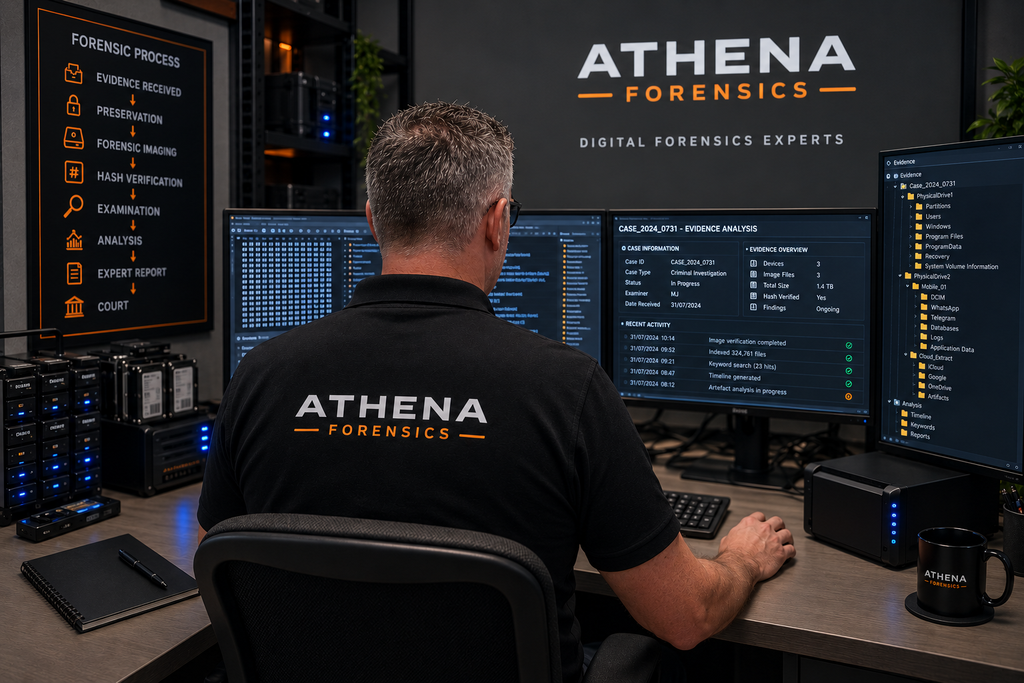
It demands a structured forensic methodology, specialist software and an experienced computer forensics expert capable of interpreting complex digital artefacts objectively.
At Athena Forensics, every examination is tailored to the circumstances of the case.
Before any forensic work begins, we establish the objectives of the investigation, identify the devices requiring examination and determine the most appropriate forensic approach.
This ensures that investigations remain proportionate, efficient and focused on answering the questions that matter most.
Criminal Investigations
Digital evidence now forms a central component of many criminal investigations. Desktop computers, laptops, external storage devices and servers frequently contain information capable of corroborating or disproving witness statements, establishing timelines or identifying user activity.
Our computer forensics experts regularly examine computers in connection with allegations involving:
- Fraud
- Theft
- Blackmail
- Harassment
- Stalking
- Financial crime
- Intellectual property offences
- Computer misuse
- Data theft
- Possession of prohibited material
- Money laundering investigations
- Organised crime investigations
A forensic examination may reveal evidence relating to internet usage, communications, document creation, deleted files, removable media usage and cloud storage activity.
Because criminal investigations require strict evidential integrity, every examination is conducted using recognised forensic procedures designed to preserve the original evidence while enabling independent verification of our findings.
Criminal Defence Investigations
Computer forensic evidence is equally important in criminal defence.
Digital evidence can demonstrate that files were created by another individual, establish that devices were accessed remotely, identify malware activity or provide alternative explanations for apparently incriminating evidence.
Athena Forensics works with defence solicitors and barristers to provide independent forensic examinations, ensuring that digital evidence is assessed objectively rather than relying solely upon prosecution findings.
Where appropriate, we review prosecution forensic reports, verify technical conclusions and identify any limitations or alternative interpretations that should be considered by the court.
Civil Litigation
Computers frequently contain important evidence in civil disputes.
Examples include:
- Contract disputes
- Commercial litigation
- Professional negligence claims
- Shareholder disputes
- Partnership disputes
- Debt recovery proceedings
- Insurance claims
Electronic documents often contain valuable metadata identifying when they were created, modified, printed or transferred between systems.
Internet activity, emails and cloud storage records may also provide important evidence regarding the actions of individuals involved in the dispute.
By examining these artefacts collectively, computer forensic experts can reconstruct relevant events and assist legal professionals in understanding the available evidence.
Family Court Proceedings
Digital evidence increasingly features in family law proceedings.
Computers may contain information relating to:
- Communication between Individuals
- Financial disclosure
- Hidden assets
- Undisclosed business interests
- Communications
- Social media activity
- Document creation
- Internet searches
- Photographs
- Cloud storage
Forensic analysis can identify deleted material, recover historical documents and establish timelines that assist the court when determining disputed issues.
All examinations are undertaken sensitively, recognising the confidential nature of family proceedings.
Corporate Investigations
Businesses frequently require independent computer forensic investigations following allegations of misconduct or security incidents.
Typical investigations include:
- Employee misconduct
- Theft of confidential information
- Breach of restrictive covenants
- Data exfiltration
- Insider threats
- Unauthorised system access
- Intellectual property theft
- Financial irregularities
- Regulatory investigations
- Internal disciplinary proceedings
Forensic examinations help establish precisely what occurred while preserving evidence suitable for potential litigation.
Digital Evidence We Recover
Modern operating systems generate enormous quantities of digital evidence.
Many users assume that deleting a file permanently removes it from a computer. In reality, numerous artefacts may remain available to forensic investigators.
Depending upon the circumstances of the examination, Athena Forensics may recover or analyse evidence including:
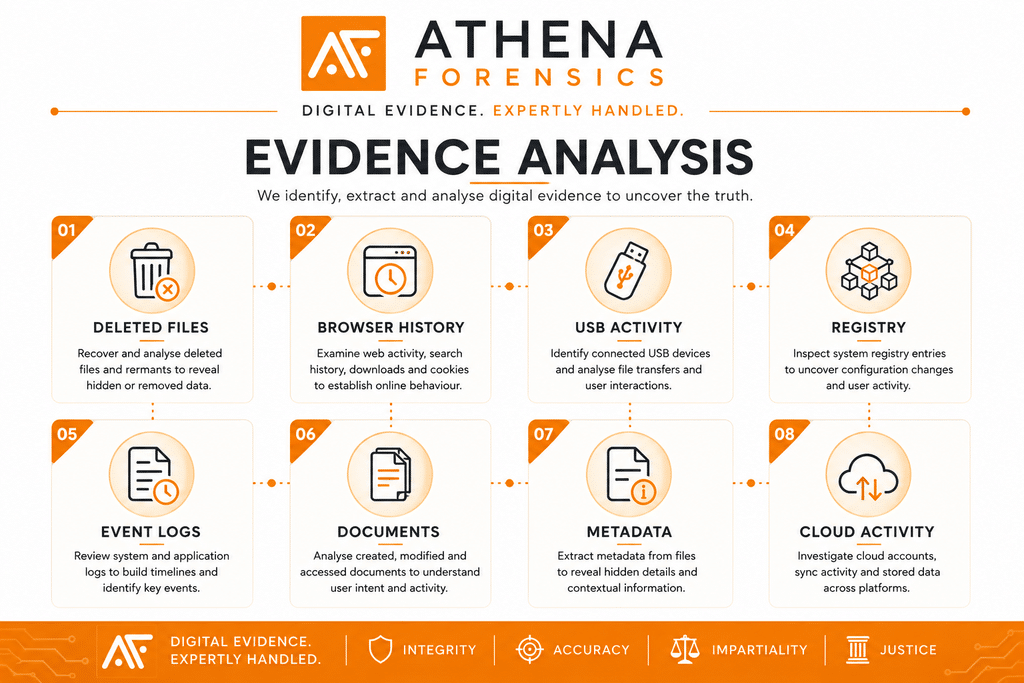
Deleted Documents
Deleted Word documents, PDFs, spreadsheets, presentations and text files may remain recoverable, particularly where they have not been overwritten.
Even where complete recovery is impossible, forensic artefacts may demonstrate that documents previously existed.
Deleted Photographs and Videos
Images and videos may survive deletion within unallocated space, backups, synchronised cloud storage or application databases.
Metadata associated with photographs can also provide valuable information regarding creation dates, editing history and transfer activity.
Internet History
Internet browsers record considerably more information than simply visited websites.
A forensic examination may identify:
- Browsing history
- Search history
- Downloads
- Cookies
- Cached content
- Saved passwords
- Autofill information
- Session recovery data
- Browser extensions
This evidence can assist in reconstructing user behaviour and establishing online activity.
Email Evidence
Emails frequently provide critical evidence.
Computer forensic experts may analyse:
- Email databases
- Attachments
- Deleted emails
- Draft messages
- Metadata
- Message headers
- Synchronisation records
Where appropriate, this information can help establish communications between individuals or identify the transmission of documents.
USB Device Usage
External storage devices frequently play an important role in investigations.
Windows and other operating systems record valuable information relating to USB devices including:
- Device identifiers
- Connection history
- Last connection times
- Drive letters
- User associations
This evidence may indicate whether confidential information was copied to removable media.
File Metadata
Documents contain considerably more information than their visible contents.
Metadata may reveal:
- Creation dates
- Modification dates
- Authors
- Editing history
- Software versions
- Printing history
This information often proves invaluable during litigation.
Operating Systems We Examine
Athena Forensics examines a wide variety of operating systems and storage environments including:
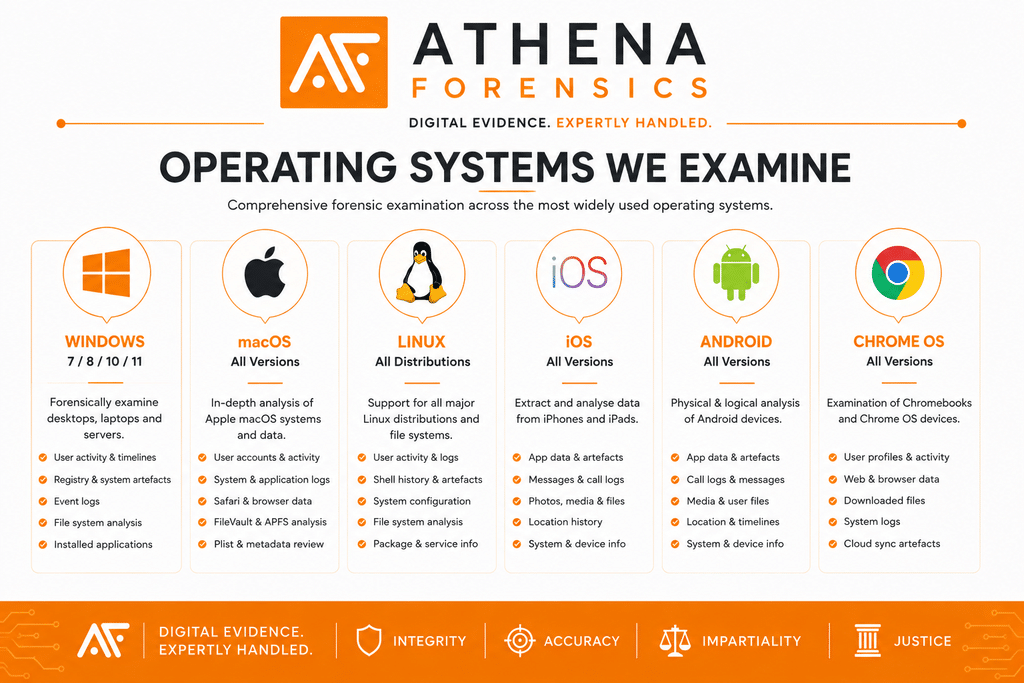
Microsoft Windows
Windows remains the most common operating system encountered during computer forensic investigations.
Significant evidence may be recovered from:
- Windows Registry
- Event Logs
- NTFS file system
- User profiles
- Jump Lists
- Recent documents
- Prefetch files
- ShellBags
- UserAssist
- Amcache
- ShimCache
- Recycle Bin
- Temporary files
These artefacts assist investigators in reconstructing user activity and application execution.
Apple macOS
Apple computers contain numerous forensic artefacts capable of identifying user behaviour.
Typical evidence includes:
- Unified Logs
- Spotlight indexing
- Safari browsing history
- Mail databases
- iCloud synchronisation
- Application artefacts
- FileVault information
- User account activity
Our forensic methodology ensures that these artefacts are preserved and interpreted correctly.
Linux
Linux systems are frequently encountered within corporate and server environments.
Investigations may include:
- User account analysis
- Shell history
- Authentication logs
- System logs
- Cron jobs
- Network configuration
- Application logs
Linux examinations often require specialist knowledge because distributions differ significantly in their architecture and logging behaviour.
Servers
Business investigations frequently involve Windows Server and Linux server environments.
Potential evidence includes:
- Authentication records
- Remote access logs
- File access
- Shared folders
- Administrative activity
- Audit logs
- Security events
Server examinations can provide valuable evidence regarding user access and organisational activity.
Our Computer Forensic Methodology
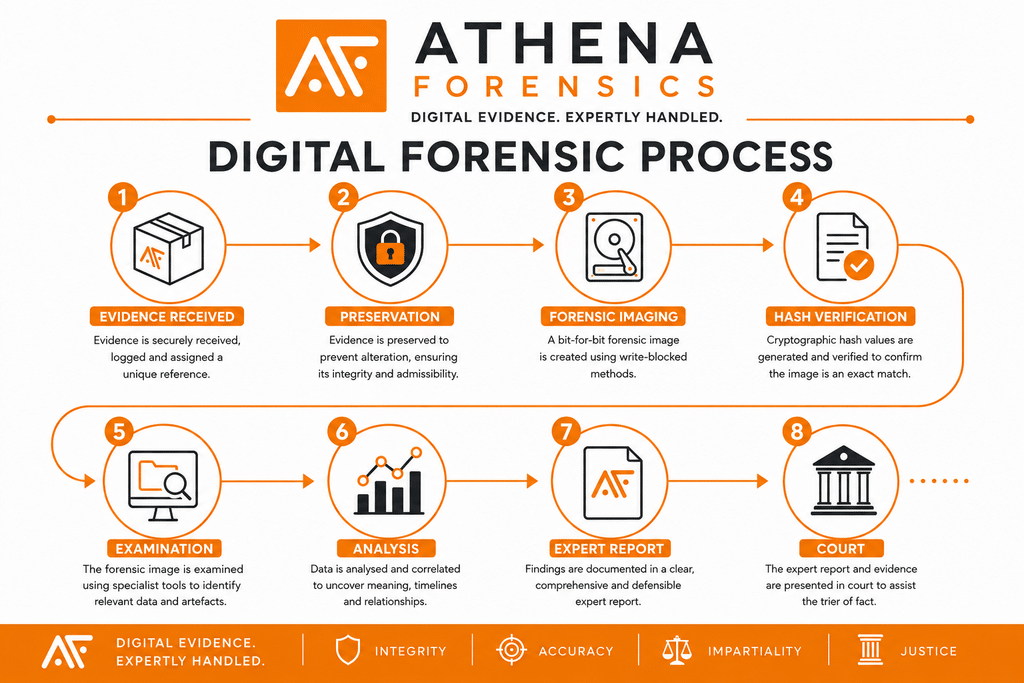
Every computer forensic investigation follows a structured methodology designed to preserve evidence and maximise reliability.
Initial Consultation
The investigation begins by understanding the client’s objectives.
We identify:
- the issues requiring investigation;
- the relevant devices;
- the potential evidence sources; and
- the anticipated legal context.
This allows an appropriate forensic strategy to be developed before evidence is collected.
Evidence Preservation
Protecting the original evidence is fundamental.
Computers are handled using recognised forensic procedures designed to minimise alteration.
Maintaining evidential integrity at this stage is essential if findings are later relied upon within legal proceedings.
Forensic Imaging
Rather than examining the original computer directly, specialist forensic software and hardware are used to create an exact bit-for-bit forensic image.
This forensic copy contains all accessible information from the original storage device, including deleted data and unallocated space where available.
Analysis is then conducted using the forensic image rather than the original computer.
Verification
Every forensic image is verified using cryptographic hash algorithms.
Matching hash values demonstrate that the forensic copy accurately represents the original evidence and has not been altered. Verification forms an essential component of every professional forensic examination.
Examination and Analysis
During analysis, investigators examine multiple evidence sources simultaneously.
Rather than relying upon a single artefact, conclusions are drawn by correlating information obtained from:
- Registry artefacts
- Event Logs
- File systems
- Metadata
- Internet history
- USB records
- Application databases
- User accounts
- Cloud synchronisation
This approach provides a more reliable reconstruction of events.
Timeline Reconstruction
One of the most valuable aspects of computer forensics is the ability to reconstruct historical activity.
By correlating timestamps from multiple independent artefacts, investigators can establish:
- when documents were created;
- when users logged in;
- when software executed;
- when USB devices connected;
- when internet activity occurred; and
- when files were transferred or deleted.
Timelines frequently become key evidence within legal proceedings.
Reporting
Our findings are documented within comprehensive reports that explain:
- the objectives of the investigation;
- the methodology employed;
- evidence identified;
- technical findings;
- limitations; and
- expert conclusions.
Reports are written clearly so that solicitors, barristers, judges and clients can understand complex digital evidence without requiring specialist technical knowledge.
Every computer forensic investigation undertaken by Athena Forensics is founded upon the principles of independence, technical excellence and evidential integrity.
By applying recognised forensic methodologies, analysing multiple evidence sources and presenting objective conclusions supported by verifiable technical findings, we provide clients with reliable digital evidence suitable for criminal investigations, civil litigation, family proceedings and corporate enquiries throughout the United Kingdom.
Industries We Support
Athena Forensics provides independent computer forensics expert services across a diverse range of industries and legal sectors. As digital technology has become central to both business and everyday life, electronic evidence now plays an increasingly important role in investigations, litigation and regulatory proceedings.
Our computer forensics experts understand that every industry has unique operational, technical and legal requirements. We tailor every forensic investigation to the objectives of the client while maintaining the highest standards of evidential integrity and professional independence.
Solicitors and Barristers
Legal professionals rely on computer forensic experts to provide independent technical evidence that is clear, objective and suitable for court proceedings.
We regularly assist with:
- Criminal defence
- Criminal prosecution
- Civil litigation
- Family proceedings
- Employment disputes
- Commercial litigation
- Professional negligence claims
- Intellectual property disputes
- Shareholder disputes
- Probate disputes
Our expert witness reports are written in plain English while retaining the technical detail required to support robust legal argument.
Businesses
Businesses increasingly require computer forensic investigations following allegations of employee misconduct, fraud or data theft.
Our investigations help organisations understand what occurred while preserving digital evidence for disciplinary proceedings, regulatory investigations or litigation.
Typical business instructions include:
- Theft of confidential information
- Insider threats
- Intellectual property theft
- Unauthorised access
- Data breaches
- Fraud investigations
- Misuse of company computers
- Employee departures
- Regulatory compliance
- Internal disciplinary investigations
- Financial Services
Financial organisations frequently require forensic investigations involving digital records, communications and transactional evidence.
Computer forensic analysis can assist in identifying:
- Financial fraud
- Data manipulation
- Unauthorised account access
- Document alteration
- Suspicious user activity
- Evidence preservation
Healthcare
Healthcare providers increasingly rely upon digital systems for patient care and administration.
Computer forensic investigations may assist with:
- Internal investigations
- Regulatory enquiries
- Security incidents
- Employee misconduct
- Data breach investigations
Confidentiality and secure evidence handling remain fundamental throughout every investigation.
Local Authorities and Public Sector Organisations
Public bodies frequently require independent computer forensic expertise during internal investigations or legal proceedings.
Athena Forensics can assist with:
- Employee investigations
- Fraud enquiries
- Regulatory investigations
- Evidence preservation
- Expert witness reports
Qualifications and Professional Standards
Selecting a computer forensics expert should involve careful consideration of qualifications, experience and professional standards.
Athena Forensics is committed to maintaining recognised forensic methodologies together with continuous professional development in the rapidly evolving field of digital forensics.
Our expertise includes:
- Computer forensic investigations
- Digital evidence analysis
- Expert witness reporting
- Mobile device forensics
- Windows forensic analysis
- Apple macOS investigations
- Linux forensic analysis
- Cloud investigations
- Internet investigations
- Data recovery techniques
We continually monitor developments in forensic software, operating systems, storage technologies and legal requirements to ensure investigations remain technically current and legally robust.
Above all, every examination is conducted objectively, independently and in accordance with recognised forensic principles.
Frequently Asked Questions
What is a computer forensics expert?
A computer forensics expert specialises in recovering, preserving, analysing and interpreting digital evidence from computers and electronic storage devices using forensic methodologies suitable for legal proceedings.
What is the difference between computer forensics and IT support?
IT support focuses on maintaining or repairing computer systems.
Computer forensics focuses on preserving digital evidence and investigating user activity using techniques designed to withstand legal scrutiny.
Can deleted files really be recovered?
In many cases, yes.
Whether deleted files remain recoverable depends upon the storage technology, operating system and any activity performed after deletion.
Even where files cannot be recovered completely, forensic artefacts may still demonstrate that they previously existed.
Can internet browsing history be recovered?
Often, yes.
Internet activity may be recoverable from browser databases, caches, operating system artefacts and other forensic evidence, even where portions of browsing history have been deleted.
Can you determine who used a computer?
Computer forensic investigations frequently identify evidence linking user accounts, login activity, application usage and document creation.
While attribution always depends upon the available evidence, forensic analysis can often assist in identifying user activity.
Can USB devices be identified?
Yes.
Windows and other operating systems record valuable information relating to removable storage devices, including connection history and device identifiers.
Do you examine Apple computers?
Yes.
Athena Forensics examines Windows, macOS and Linux systems together with servers and external storage devices.
Can evidence be used in court?
Digital evidence obtained using recognised forensic methodologies can be presented within criminal, civil and family court proceedings.
Where appropriate, our computer forensics experts also provide expert witness reports and attend court.
How long does a forensic examination take?
The timescale depends upon the size of the storage device, complexity of the investigation and objectives of the examination.
Straightforward investigations may be completed within days, whereas larger commercial investigations may require significantly longer. Timescales are provided as part of our quotation process.
Do Athena Forensics work throughout the UK?
Yes.
Athena Forensics provides computer forensic investigations and expert witness services for clients across England, Wales, Scotland and Northern Ireland.

Digital evidence is now one of the most significant forms of evidence encountered within criminal investigations, civil litigation, family proceedings and corporate disputes. Identifying, preserving and interpreting that evidence requires specialist knowledge, recognised forensic methodologies and a commitment to independence and accuracy.
At Athena Forensics, our computer forensics experts provide professional, impartial and technically robust forensic investigations designed to establish the facts. Whether recovering deleted files, reconstructing user activity, investigating allegations of fraud or preparing expert witness reports for court, our objective remains the same—to deliver reliable digital evidence that withstands scrutiny and assists our clients in making informed decisions.
By combining advanced forensic techniques with clear communication and an unwavering commitment to evidential integrity, we help solicitors, businesses, organisations and private individuals understand the digital evidence that matters most.
Contact Athena Forensics
If you require an experienced computer forensics expert, Athena Forensics is ready to assist.
Our specialists provide independent computer forensic investigations, digital evidence analysis and expert witness services throughout the United Kingdom.
Whether you require assistance with a criminal investigation, civil litigation, family proceedings, employment dispute or corporate investigation, we will work with you to identify the most appropriate forensic approach and provide clear, objective findings supported by recognised forensic methodology.
Contact Athena Forensics today for a confidential initial consultation and discover how our experienced computer forensics experts can help preserve, recover and interpret the digital evidence critical to your case.
About Athena Forensics
For information on our computer forensic expert services or if you require any advice or assistance please contact a member of our team on 0330 123 4448 or via email on enquiries@athenaforensics.co.uk, further details are available on our contact us page.
Our client’s confidentiality is of the utmost importance. All correspondence is treated with discretion, from initial contact to conclusion of the matter.
We are fully aware of the significance and importance of the information that they encounter and we have been accredited to ISO 9001 for 14 years.
Our premises along with our security procedures have been inspected and approved by law enforcement agencies and we do not disclose personal information to other companies or suppliers.
Our team are all security cleared and we offer non-disclosure agreements if required.
Our premises along with our security procedures have been inspected and approved by law enforcement agencies.
Athena Forensics do not disclose personal information to other companies or suppliers.